Interactive pinyin chart: pick a tone, hear the pronunciation and see example characters for every Chinese syllable.
a
o
e
i
u
ü
ai
ei
ao
ou
an
en
ang
eng
ong
er
ia
ie
iao
iu
ian
in
iang
ing
iong
ua
uo
uai
ui
uan
un
uang
ueng
üe
üan
ün
b
p
m
f
d
t
n
l
g
k
h
j
q
x
zh
ch
sh
r
z
c
s
Pronunciation tips
jj — like a soft 'j', tongue against the palate, NO aspiration.
qq — like j but strongly aspirated.
xx — like 'sh' but tongue near the palate, light hiss.
zhzh — curl the tongue back, then 'j', unaspirated.
chch — like zh but aspirated.
shsh — retroflex 'sh', tongue curled back.
rr — retroflex, close to English 'r', slightly buzzed.
zz — like 'ts', unaspirated.
cc — like z but strongly aspirated.
ss — plain 's'.
üü — round the lips like 'u' but say 'ee'.
ee — a throaty 'uh' (not English 'e').
erer — 'uh' with the tongue curled.
Telling zh–z / ch–c / sh–s apart
Learners often struggle to distinguish zh–z, ch–c and sh–s: the sounds are very similar and differ only in tongue position and aspiration.
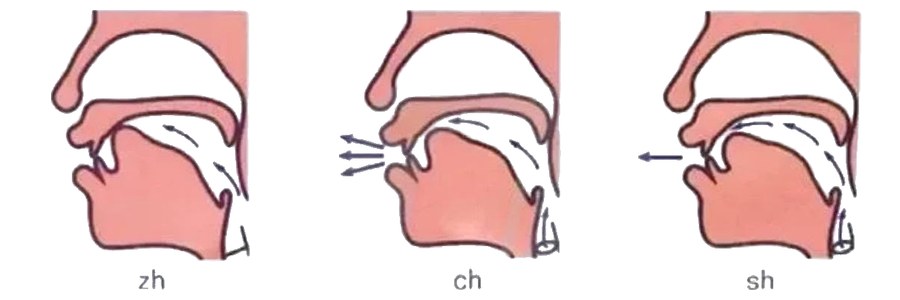
The zh – ch – sh group Retroflex sounds (卷舌音)
The tip of the tongue curls up and touches the front of the hard palate to block the airflow.
zhRetroflex affricate, unaspirated. The tongue tip curls up against the hard palate; air is released with friction. Vocal cords do not vibrate.
chSame tongue position as zh, but released with a strong burst of air.
shRetroflex fricative. The tongue tip curls up close to the hard palate and air escapes through the narrow gap with friction. Vocal cords do not vibrate.
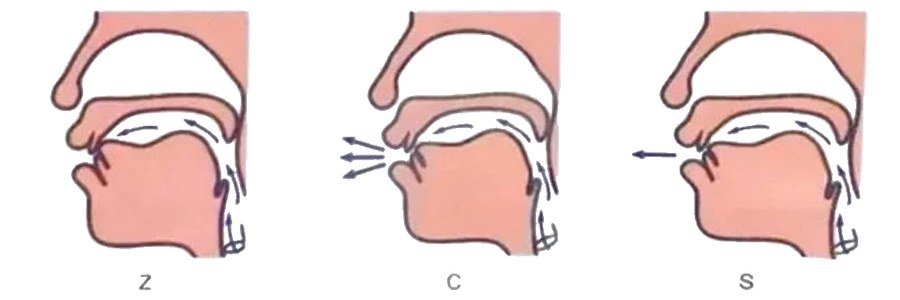
The z – c – s group Flat-tongue sounds (平舌音)
The tongue tip lightly touches the base of the upper teeth, blocking the airflow in the mouth while the soft palate rises to stop air escaping through the nose.
zDental affricate, unaspirated. The tongue tip touches the upper teeth, then pulls back slightly to form a narrow gap for the air to buzz through.
cSame tongue position as z, but the air is released much more forcefully.
sDental fricative, unaspirated. The tongue tip approaches the upper teeth forming a narrow gap; air escapes with friction.
Sound
Tongue
Aspiration
zh
↗ Curled
✕
ch
↗ Curled
✓
sh
↗ Curled
✕
z
→ Flat
✕
c
→ Flat
✓
s
→ Flat
✕
Practice tips
Practice each pair zh–z / ch–c / sh–s in front of a mirror to watch your tongue: zh–ch–sh needs the tongue curled up, z–c–s keeps it flat.
For the aspirated sounds ch and c, hold a small piece of paper in front of your mouth: if it flutters strongly, the aspiration is right.
Listen to the samples on the pinyin chart and shadow native-speaker videos to get used to the standard sounds.
Read aloud, record yourself and listen back every day to adjust your mouth shape and aspiration for each sound.